Ukraine’s Middle East push: Zelensky’s Syria visit signals a new geopolitical contest

Opinion 12-04-2026 | 13:11

Ukraine’s Middle East push: Zelensky’s Syria visit signals a new geopolitical contest

Between reconstruction opportunities and shifting alliances, Damascus becomes a new arena in the global Russia–Ukraine rivalry.

Ukraine’s Middle East push: Zelensky’s Syria visit signals a new geopolitical contest
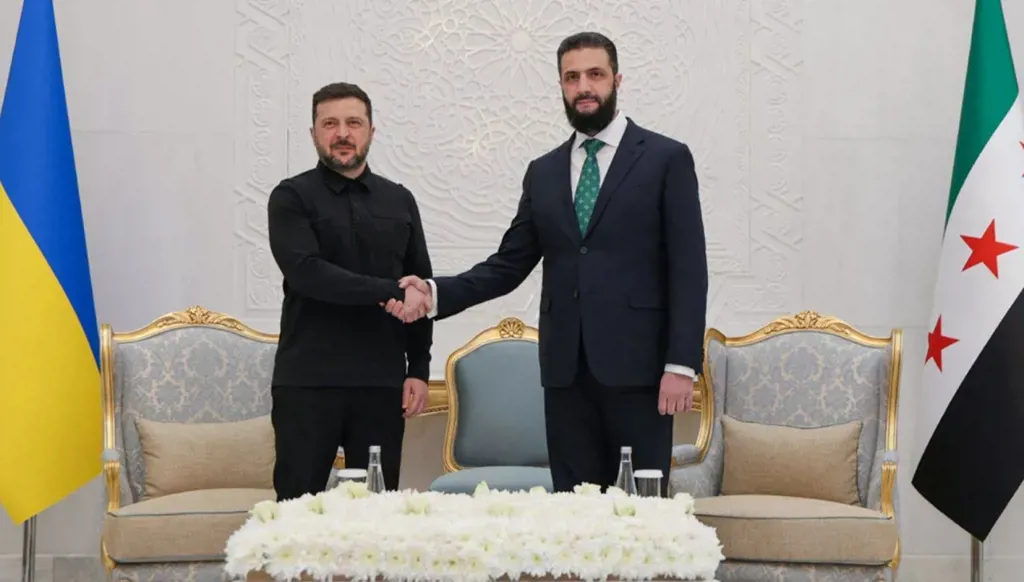
Al-Sharaa received Zelensky in Damascus (AFP)
Smaller Bigger


Observers noted the visit made by Ukrainian President Volodymyr Zelensky to Syria last Monday, as the American-Israeli war impacts the Middle East and the world, reshaping the regional scene for generations to come.


Zelensky’s visit to Damascus, the first by a Ukrainian leader since the fall of Bashar al-Assad’s regime on December 8, addresses Syria’s need for two essential priorities in the reconstruction phase after a 14-year war: restoring the country’s economic and military capacities. The Ukrainian president did not hide his country’s interest in what he called “developing military and security relations with Syria.”

Questions

Several questions arise alongside this visit: first, the notable timing coinciding with the Iran War; second, what impact the visit might have on the historical relations between Syria and Russia, which still maintains two military bases in Tartus and Latakia, especially in light of two visits Syrian President Ahmad al-Sharaa made to Moscow since coming to power; and third, what role did Ankara play in facilitating Zelensky’s visit and promoting Syrian-Ukrainian relations?


It should be noted that Zelensky’s visit to Syria came after a tour of several Gulf Arab countries, which resulted in agreements to provide those countries with Ukrainian expertise in countering Iranian drones. Kyiv has extensive experience in this field, given Tehran’s supply of Iranian “Shahed” drones to Moscow since the beginning of the Russian-Ukrainian war over four years ago.

Seizing the opportunity


Zelensky did not miss the opportunity created by the Iran War to expand Ukraine’s presence in the Middle East at Russia’s expense, as the latter maintains strong relations with Tehran. Russia faces significant embarrassment following unjustified Iranian attacks on infrastructure in Gulf Arab countries, noting that these countries refused to grant facilities to the American forces participating in the war.


Zelensky has military and economic assets in his campaign to expand Ukraine’s presence in Syria, namely wheat and drone technology. As is known, Damascus has relied on Soviet weapons for decades. Kyiv can play a significant role in this area, relying largely on the weapons it inherited from the former Soviet Union.


Moreover, Syria, which had relied on Russian wheat, can now replace it with Ukrainian wheat if it seeks to reconsider its relations with Russia. However, Damascus remains cautious in this regard and does not want to turn against Moscow, while indicating that it is moving towards establishing balanced relations with a broader circle of countries, both East and West, and using this approach in the reconstruction phase.


Therefore, it can be concluded that Syrian openness to Ukraine does not necessarily come at the expense of Syrian-Ukrainian relations, even though Russian diplomacy is not present in the Middle East with the strength it should have in such a sensitive phase in the region’s history.


What can be described as active Ukrainian diplomacy seeks to reduce Russian influence in the region, following similar attempts in Africa. However, Russia, weakened by the war in Ukraine both militarily and economically, does not appear poised to withdraw from areas where it has historically held sway, including Syria. Moreover, Moscow maintains strategic relationships with Gulf countries, notably through the “OPEC+” organization, which plays a crucial role in determining global oil production levels and price ceilings.


Thus, there is currently a Russian-Ukrainian conflict over influence abroad. Each side seeks to assert its presence in various regions, relying on its capabilities and resources.