

Navarone’s lesson in real life: The Strait that controls the world



 Messenger
 Whatsapp
 Threads
 Email
Email
 Print
Print
 X
X
 Facebook


In the novel The Guns of Navarone, an imaginative story set during World War II that was adapted into a thrilling film, two massive cannons are positioned on a narrow bay (imaginarily located in the Greek islands), where an Allied battalion is trapped and can only be rescued by destroying those fortified guns, or they face annihilation. The narrative (film) showcases the bravery involved in that destruction, keeping viewers on the edge of their seats. German superiority wasn’t based on the number of soldiers or geographic spread, but on a simpler idea: placing a decisive weapon in a commanding position.
Just two cannons, but in the right location, were able to paralyze an entire fleet and prevent a broad rescue operation. This literary idea eventually evolved into one of the most important concepts in modern military thinking: power lies not in its size, but in its positioning.
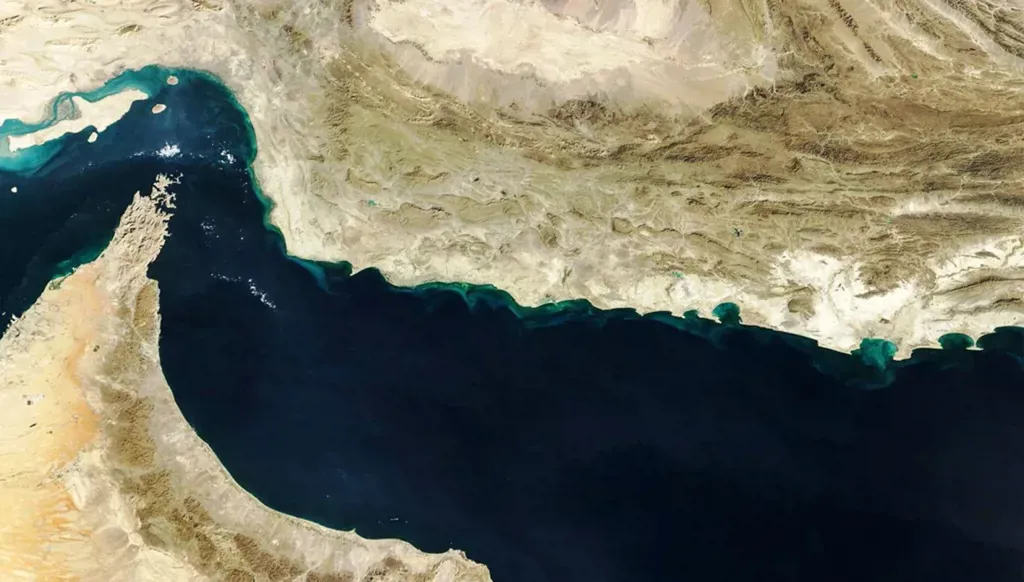
Today, this idea doesn’t seem far from reality; it almost manifests literally in the Strait of Hormuz. This narrow passageway, through which about a third of the world’s sea-borne oil trade and nearly half of the agricultural fertilizers pass, has become closer to a real “Navarone”—not with guns in the classical sense, but with a network of tools: coastal missiles, fast boats, naval mines, and drones. Tools that might seem disparate, but when positioned in this particular geographic site, become formidable deterrents.
Iran, aware of its limited capability to engage in an open conventional confrontation with major powers, has over the years developed what can be called a “Navarone strategy,” maximizing impact with limited tools by controlling a choke point of a global artery. It doesn’t need to permanently close the strait; creating a serious threat of closure or carrying out sporadic strikes that disrupt navigation is enough, turning the fear itself into a powerful deterrent.
However, as in the novel, every concentrated point of strength carries within it a concentrated weakness. The guns of Navarone could control the sea, but they were static, with known locations, and vulnerable to destruction through a precise, specialized operation. This raises the most important question: how can the “Navarone siege” be lifted in its modern form—i.e., in the Strait of Hormuz?
The answer does not lie in a full-scale confrontation, but in dismantling the power elements themselves.
First, neutralize the ability to close the strait, not control the geography. By nature, the strait cannot be fully “occupied,” but the effectiveness of disruptive tools can be reduced through preemptive operations targeting missile platforms, mine storage facilities, and fast boat bases. In other words, strike the “tools” rather than engaging with the “domain.” And this is exactly what is happening.
Second, break the geographic monopoly. Part of Hormuz’s strength is that it’s a quasi-mandatory passage, but investing in alternatives — such as land oil pipelines through Saudi Arabia and the UAE to the Arabian Sea, or modern railways — reduces the centrality of the strait, turning the threat from “complete choking” into a “manageable nuisance” and depriving Iran of its long-term benefits. In the world of energy and supply chains, diversifying transportation methods is not only economical but also a strategic measure for long-term security.
Third, build a permanent protective umbrella for navigation. Not through temporary reactions, but through sustained naval presence and advanced technologies for mine detection and drone neutralization, combined with effective regional and international coordination, any attempt to close the strait becomes politically costly before it becomes militarily challenging. In this way, the strait shifts from a “weak point” to an “intensively monitored point.”