

Iranian gunboats fire on tanker in Strait of Hormuz as Iran reimposes restrictions



 Messenger
 Whatsapp
 Threads
 Email
Email
 Print
Print
 X
X
 Facebook
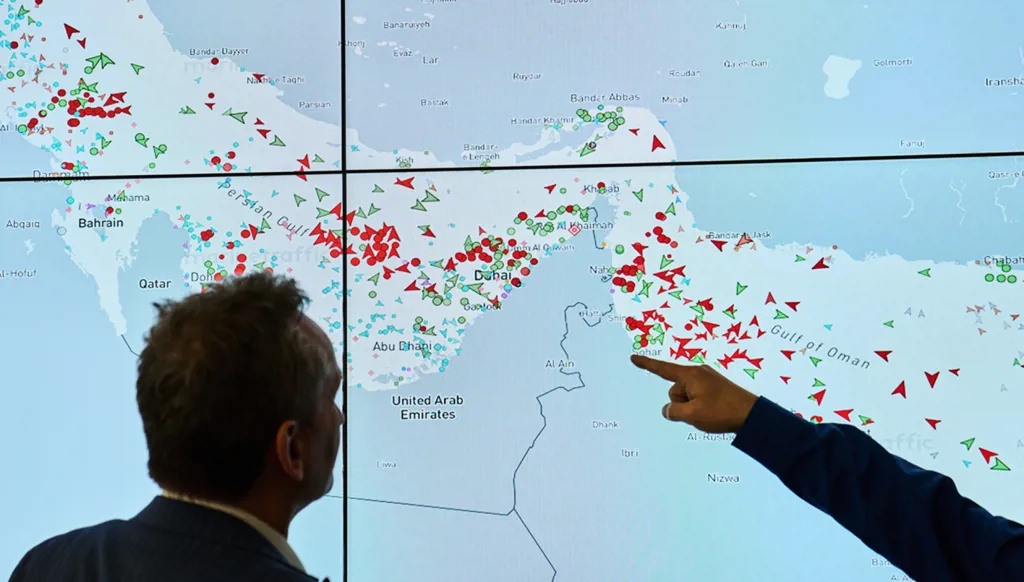


Iran rowed back on its decision to reopen the Strait of Hormuz and fired on a tanker attempting to pass the waterway on Saturday. It warned that it would continue to block transit through the strait as long as the U.S. blockade of Iranian ports remained in effect.
Confusion over the critical chokepoint threatened to deepen the energy crisis roiling the global economy and push the two countries toward renewed conflict, even as mediators expressed confidence a new deal was within reach.
Iran’s joint military command said on Saturday that “control of the Strait of Hormuz has returned to its previous state ... under strict management and control of the armed forces.”
Two gunboats from Iran’s Revolutionary Guard opened fire on a tanker transiting the Strait of Hormuz, the British military’s United Kingdom Maritime Trade Operations center said. It reported the tanker and crew as safe, without identifying the vessel or its destination. TankerTrackers.com reported vessels were forced to turn around in the strait, including an Indian-flagged super tanker, after they were fired on by Iran.
Saturday's developments came after U.S. President Donald Trump said the blockade “will remain in full force” until Tehran reaches a deal with the U.S., including on its nuclear program. Tehran had reopened the strait Friday to commercial vessels.
Roughly one-fifth of the world’s oil passes through the strait and further limits would squeeze already constrained supply, driving prices higher once again. Iran’s Friday announcement about the opening of the crucial body of water, through which 20% of the world’s oil is shipped, came as a 10-day truce between Israel and the Iranian-backed Hezbollah militant group in Lebanon appeared to hold.
Despite the escalation, Pakistani officials say the United States and Iran are still moving closer to a deal ahead of the April 22 ceasefire deadline.
The fighting has killed at least 3,000 people in Iran, nearly 2,300 in Lebanon, 23 in Israel and more than a dozen in Gulf Arab states. Thirteen U.S. service members have also been killed.
Here is the latest:
Iran’s supreme leader sends defiant messages
Iran’s “valiant navy” is “ready to inflict new bitter defeats on its enemies,” Supreme Leader Ayatollah Mojtaba Khamenei said.
Khamenei’s defiant remarks came as Iran swiftly reimposed restrictions on the Strait of Hormuz.
In a message celebrating the anniversary of the establishment of Iran’s army, he hailed Iran’s drone strikes that targeted Israel and the U.S. interests across the region during the war.
Indian ships reverse course in Hormuz strait, vessel tracker says
Two Indian vessels have had to reverse course in the Strait of Hormuz following reports of gunfire from Iran’s Revolutionary Guard, a vessel-tracker said.
TankerTrackers.com said the vessels include an Indian-flagged super tanker, carrying 2 million barrels of Iraqi oil.
Iranian gunboats fire on tanker, British military says
The British military says two gunboats from Iran’s Revolutionary Guard opened fire on a tanker transiting the Strait of Hormuz after Iran said it had reimposed restrictions on the vital waterway.
The United Kingdom Maritime Trade Operations Centre said the tanker and crew were reported safe, without identifying the vessel or its destination.
Iran said earlier it was reimposing restrictions on the strait in response to a U.S. blockade on Iranian shipping and ports. Iran has prevented vessels from crossing throughout the seven-week-long war, except for ones it authorizes.
Iran says it won’t hand over enriched uranium to US
Iranian Deputy Foreign Minister Saeed Khatibzadeh dismissed claims from U.S. President Donald Trump over the uranium and sounded a note of caution with regard to future talks between the two countries.
Speaking to the Associated Press in the Turkish city of Antalya, Khatibzadeh said the Iranians were not ready for a new round of face-to-face talks with the U.S. because the Americans “have not abandoned their maximalist position.”
On Friday, Trump said the U.S. will go into Iran and “get all the nuclear dust,” referring to the 970 pounds (440 kilograms) of enriched uranium believed to be buried under nuclear sites badly damaged by U.S. military strikes last year.
Lebanese leaders discuss future talks with Israel
The meeting between President Joseph Aoun and Prime Minister Nawaf Salam came during a 10-day ceasefire between Israel and Lebanon’s Iran-backed Hezbollah group.
According to a statement from Aoun’s office, the pair discussed Lebanon’s “readiness for negotiations” with Israel. Lebanon and Israel have been in a state of war since 1948.
Earlier this week, the two countries’ ambassadors to the U.S. held a meeting, in the first direct talks in decades.
U.S. President Donald Trump has invited Aoun and Israeli Prime Minister Benjamin Netanyahu to the White House, although no date has been set yet.
Aoun has said he is ready to go anywhere to “liberate my country, protect my people and save my nation.”
Iran reimposes restrictions in Strait of Hormuz
Iran has reversed course on reopening the Strait of Hormuz, reimposing restrictions on the critical waterway after the U.S. said the move would not end its blockade.
The country’s joint military command said “control of the Strait of Hormuz has returned to its previous state ... under strict management and control of the armed forces.”
It warned that it would continue to block transit through the strait as long as the U.S. blockade of Iranian ports remained in effect.
The announcement came the morning after U.S. President Donald Trump said the U.S. blockade “will remain in full force” until Tehran reaches a deal with the U.S., including on its nuclear program.