

Delaying national reconciliation threatens Syria’s unity and stability



 Messenger
 Whatsapp
 Threads
 Email
Email
 Print
Print
 X
X
 Facebook


As the situation in Syria approaches a critical moment, I assert that delaying efforts for national reconciliation threatens to divide and fragment the country in the very near future.
While Netanyahu expresses surprise at the accelerated concessions provided by the Syrian side for advancing security negotiations, the United States is exerting maximum pressure on Syria to sign a security agreement with Israel. Meanwhile, Israel insists on a contractual agreement with the Syrian administration, rendering Damascus a militarily fallen city in Israel's hands for an indefinite period.
Israel also sets maximum conditions to limit Syria's capabilities in developing its air defenses, including missiles and drones, and demands the handover of security files on individuals residing on Syrian territories whom it considers a threat to its security. In this context, the Syrian authorities repeatedly state that Syria will not pose a threat to any of its neighbors.
If the Syrian administration is willing to sign long-term security agreements with Israel, and if it does not wish to engage in war with its "good" neighbors - Israelis, Turks, and Iranians - then who are the villains? For whom does the war bell toll in Syria? Why are the Syrian army and military preparing, and against whom? Who is the enemy?
Instead of the Syrian government moving toward partial security agreements with Israel, the real political and negotiation efforts to achieve voluntary national reconciliation among Syrians are being delayed, with the goal of reaching a sustainable civil peace and establishing a model of a decentralized nation-state. A nation-state built on an inclusive democratic civil social contract, which serves as the primary source of rights and the basis for the state’s monopoly on violence, regulating relations among all Syrians of different backgrounds - not limited by sect or ethnicity. A social contract that establishes a unified military doctrine for the national Syrian army, reflecting the state’s doctrinal neutrality and free from sectarian, religious, or ethnic affiliations.
What does it mean for the internal situation to remain stagnant without voluntarily and consensually unifying the country? What does it mean to go towards partial agreements with Israel, granting it everything it wants and stripping Syria of sovereignty over a significant portion of its land, turning Damascus into a militarily and objectively fallen city? And what does it mean to proceed with partial internal agreements while delaying the production of a social contract and a consensual Syrian constitution?
Without the unity of the Syrian people in heart and form, American guarantees will not protect Syria (as evidenced in Gaza), nor the agreements with its "good" neighbors.
I claim that delaying voluntary and contractual national reconciliation and achieving transitional justice will practically mean the continuation of extremist discourse and the consolidation of ideological rhetoric for liberating Jerusalem under the pretext of the absence of peace on one hand, but on the other hand, it will entrench the division within the country indefinitely and keep the flames of internal war burning, threatening a definitive split of the country!
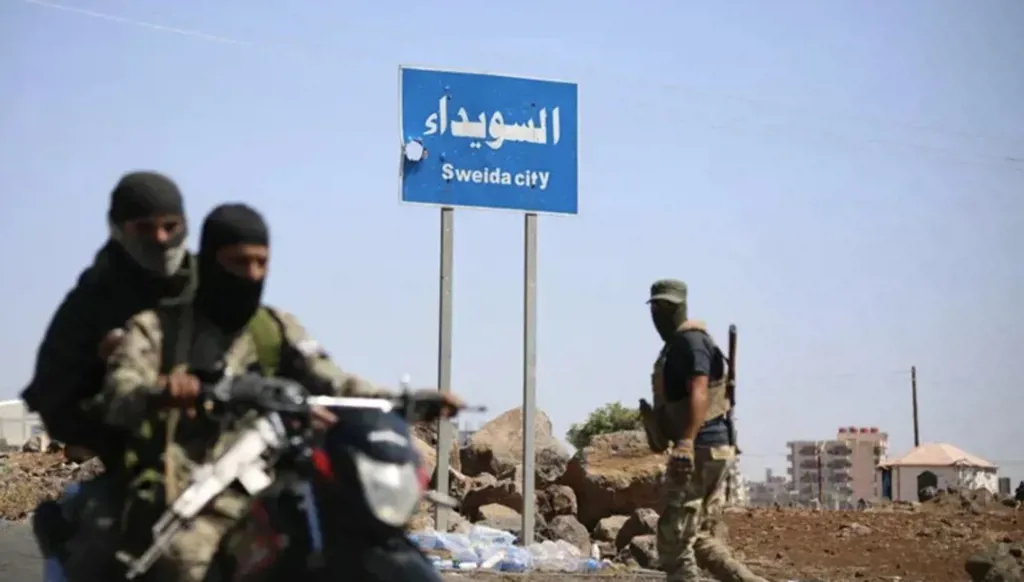
Whether in the east of the Euphrates, Jabal al-Arab, northwest Syria, or northern Syria where Turkish-aligned factions control (which the UK recently sanctioned), a de facto reality emerges outside the control of the central state.
There is a significant danger to the country's future from rushing into risky partial security agreements with external parties, in exchange for slow-moving national contractual reconciliation internally.
The core idea relates to priorities: Which should come first? Should the state be built from the inside first - with a new social contract - then external files managed from a position of national unity? Or should external threats be managed first at the expense of delaying the "contract," anchoring division, hardening weakness, and allowing the logic of extremism and internal fighting to prevail, reviving extreme narratives in public arenas: a strict religious discourse on one hand, and broad motivational rhetoric on the other, with a reality that gradually fragments.
At that point, division becomes not just a political divergence; it transforms into zones of influence, parallel institutions, economic and security loyalties, and "narratives" about legitimacy that do not converge.
What must be worked on is a decentralized national contractual reconciliation, producing a comprehensive democratic civil social contract, serving as a source for rights and duties, redefining Syrians' relationship with the state based on citizenship, not sect or ethnicity. The state is not only built by constitutions, but also by reinforcing the neutrality of sovereign institutions towards sub-identities, making the role of power to protect the national sphere, not represent a particular group, and ensuring that each external file is approached as a mirror of internal unity, not its crisis, where delaying internal settlement offers an opportunity for external intervention.
The dilemma of security arrangements assumes, to begin with, the existence of a single, unified state capable of transforming calm into political construction. But when the internal sphere is divided among actual authorities and areas of influence, the calm does not automatically transform into reunification; instead, it solidifies division.
There will be no peace at the borders unless preceded by peace within.
Disclaimer: The opinions expressed by the writers are their own and do not necessarily represent the views of Annahar.