

Dubai’s World Government Summit: Shaping the future of governance
From AI-powered cities to agile institutions, the summit reveals how the Gulf is turning bold ideas into daily policy—and why the rest of the Arab world is racing to catch up.



 Messenger
 Whatsapp
 Threads
 Email
Email
 Print
Print
 X
X
 Facebook
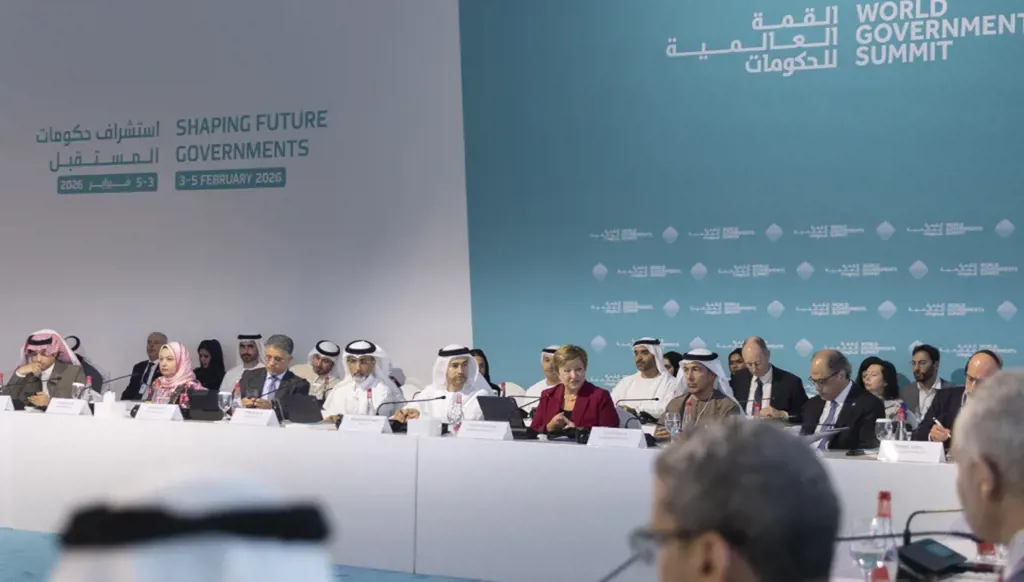


The World Government Summit is no longer just an annual gathering to exchange ideas on public administration; it has become a platform reflecting a deeper shift in the world’s view of the state and its role. What stands out this year is that the summit's discussions, which conclude today in Dubai, do not merely diagnose or predict international developments, they clearly focus on turning questions into actionable tools and policies, acknowledging that the traditional governance model can no longer keep pace with a rapidly changing, multi-faceted world.
The summit proceeds from an understanding that governments today operate in constant uncertainty with geopolitical crises, accumulating economic pressures, demographic shifts, and technological acceleration that often outpaces legislation and institutions. In this context, the concept of an “effective government” is not presented as synonymous with power or centralization, but as the ability to build institutional resilience, anticipate challenges, and manage risks before they escalate into existential crises. The future, as the summit demonstrates, cannot be addressed when crises arise; they must be managed daily with tools for measurement, foresight, and adaptation.
This shift in governance thinking finds its clearest echo in the Gulf region, which participates in the summit not only as a resource-rich area but also as a practical laboratory for new policies. Gulf countries, benefiting from stability and swift decision-making, appear more ready to experiment with advanced models in digital governance, the use of artificial intelligence in public administration, and the redesign of cities and transportation systems. This presence reflects a growing Gulf orientation toward developing more integrated governance models, relying on innovation and institutional flexibility as means to enhance government effectiveness and public services during a period of deep economic and technological transformation.
At the heart of this regional scene, the UAE experience stands out as a comprehensive expression of what the summit calls “Shaping Future Governments.” The United Arab Emirates does not present itself as a state that has reached a finalized, fully developed model, but as a country in open development, updating daily, and subject to continuous review. Here, the state is not a fixed bureaucratic machine but an institutional system whose tools change with the challenges. This year’s summit shows a clear shift from the stage of vision and slogans to that of tools and implementation, translating concepts—such as innovation, well-being, and foresight—into public policies, performance indicators, and mechanisms for measurement and accountability, reflecting a practical understanding that the future is managed not by intentions but by the ability to implement.
However, while highlighting this path, the summit simultaneously raises a broader question concerning the rest of the Arab world. According to the summit’s logic, the gap between the Gulf and the rest of the Arab world is not one of resources or human talent but of governance, vision, and policy continuity. Many Arab states remain trapped in day-to-day crisis management, unable to plan long-term or to make the future a clear political priority. In this context, the summit does not offer a ready-made model for replication but clearly hints that the problem is an inability to transform ideas into sustainable, actionable public policies.
In conclusion, as the World Government Summit draws to a close, it does not claim to have final answers to the world’s crises, but it succeeds in reframing the fundamental question of this era of major transformations: will governments remain reactive and focused on emergency management, or will they become active agents designing their future with clear tools and executable decisions? Between a world redefining its rules, a Gulf testing new government models, and a UAE experience working to turn foresight into daily policy, it seems that the real struggle is no longer just over resources, but over governance models capable of turning the future from an idea into practice.