

Egypt’s 8 Constitutions: A century of revolutions, power shifts, and political reinvention
From monarchy to republic, from Nasser to Sisi, Egypt’s constitutional history mirrors its political upheavals, where every regime change reshapes the state’s founding legal order.



 Messenger
 Whatsapp
 Threads
 Email
Email
 Print
Print
 X
X
 Facebook
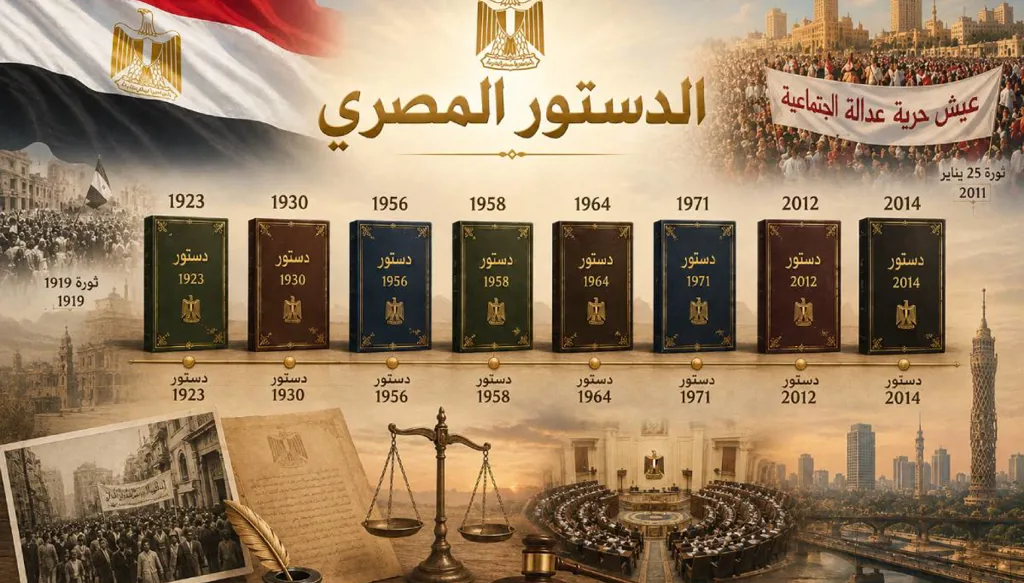


In the last century, Egypt has seen 8 constitutions, a relatively large number by the standards of contemporary nations, reflecting significant political and social transformations since the adoption of its first modern constitution in 1923.
There is a clear relationship between the number of constitutions and the political conditions of countries. For example, from the Constitution of the French Revolution in 1791 up to the establishment of the Fifth Republic in 1958, France was governed under 8 constitutions, with only the current republican constitution remaining in force.
Similarly, the United States, one of the most constitutionally stable countries, has not changed its constitution since 1787.
The same applies to Cairo, where constitutional changes have coincided with revolutions, regime changes, and shifts in political leadership. The executive power has played a predominant role in drafting the constitution, according to observers and politicians.
.jpg)
Succession of constitutions and the executive authority's role
Dr. Amr Hashem Rabie, a consultant at the Al-Ahram Center for Political and Strategic Studies and a member of the National Dialogue Board of Trustees, explains that this succession is the result of changing ruling regimes and multiple political identities.
Rabie told Annahar: “The ruling systems varied and the state’s identities multiplied. The regime was monarchical, then republican, and within the republic it was sometimes pluralistic and sometimes not. At times the state’s identity was socialist, at others it was capitalist, or dominated by a religious trend.”
Regarding opinions that the executive authority had a major influence on drafting the constitution, Rabie points out that “of course, the authority was the strongest and most controlling, due to the centralized nature of the regime.”

Constitutions before and after July 23, 1952
Politician and former Egyptian parliamentarian Dr. Mohamed Abou Hamed sees Egyptian constitutions as divided into two periods: before and after the 1952 revolution. He told Annahar: “The 1923 Constitution is, in my view, the best because it was a purely constitutional text. The period following the 1952 revolution saw constitutions influenced by revolutions and by the orientations of the governing authorities.”
He adds: “For example, the 1956 Constitution reflected the orientations of the July 23, 1952 Revolution, the 1958 Constitution was drafted for unity with Syria, and the temporary 1964 Constitution sought to mitigate regime dominance and reduce centralization.”
The Egyptian politician continues: “After President Gamal Abdel Nasser’s death, the 1971 Constitution was introduced during President Anwar Sadat’s era, reflecting the political orientations of the time and incorporating religion as a primary source of legislation, marking a ‘soft revolution’ against the previous ideology. Amendments in 2005 and 2007 were also aimed at serving the ruling authority’s political vision at that time.”

The Succession of constitutions and constitutional declarations
Many agree with Abou Hamed that the 1923 Constitution was the best, as it demanded freedom and independence from British occupation and was drafted by a committee composed of political and popular leaders, religious figures, businessmen, and others, known as the “Committee of Thirty.”
In 1930, King Fuad I abolished the constitution, replacing it with one that expanded his powers; then the 1930 Constitution was repealed and the 1923 Constitution was reinstated in 1936.
The 1952 Revolution abolished the monarchy and established a republic, followed by a constitutional declaration and the 1956 Constitution. Two years later, the “United Arab Republic” was formed to unite Egypt and Syria, leading to the adoption of the 1958 Constitution, which collapsed shortly thereafter, resulting in the temporary 1964 Constitution.
After President Nasser’s departure, the 1971 Constitution emerged during President Sadat’s era, initiating a new phase that continued through President Hosni Mubarak’s era until he relinquished power in 2011. The constitution was suspended and a constitutional declaration was issued.
Following the popular demonstrations that led to Mubarak’s ousting, the Muslim Brotherhood and their Islamist allies gained control, securing a majority of parliamentary seats and the presidency, and passing the controversial 2012 Constitution in what was described as an “invasion of the ballot boxes.”
Within less than a year, the Brotherhood lost credibility, revealing their true character, and millions of Egyptians demanded an “end to the rule of the Supreme Guide.” The Egyptian army sided with the people, removing the Brotherhood leader, the late Dr. Mohamed Morsi, from the presidency and suspending the constitution.
A new committee was formed to draft the 2014 Constitution, which was approved, followed by presidential elections won by the current Egyptian president Abdel Fattah el-Sisi. This constitution has been in force for 12 years and was amended once in 2019.