

Macron’s Armenia visit and the geopolitical signals in the Caucasus
A symbolic diplomatic visit highlighting France’s growing role in Armenia, regional power balances in the Caucasus, and Russia’s cautious media response through a strategy of restrained neutrality.



 Messenger
 Whatsapp
 Threads
 Email
Email
 Print
Print
 X
X
 Facebook


Dr. Khaled Al-Azzi
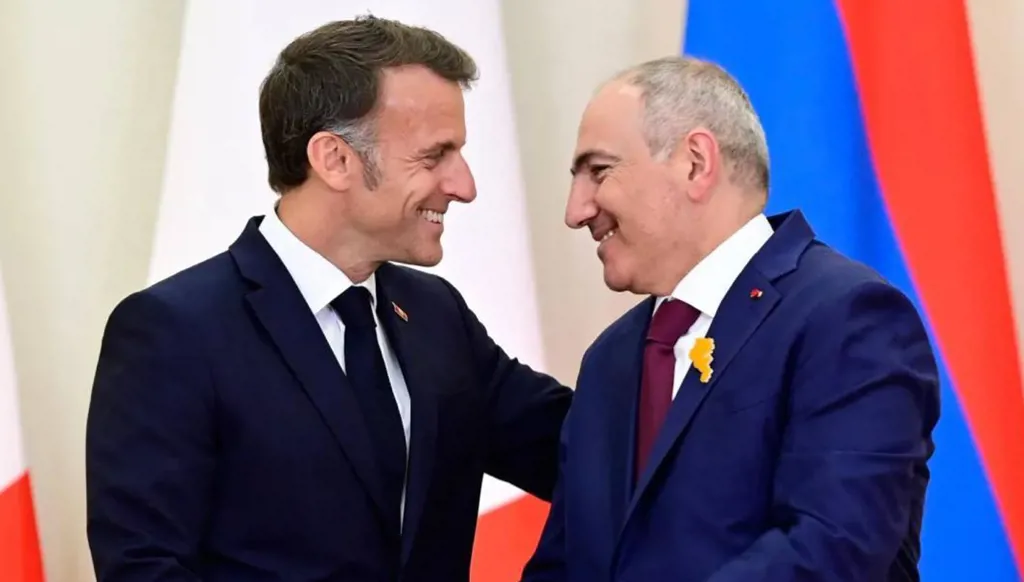
French President Emmanuel Macron arrived in Armenia on April 4, 2026, as part of the European Union delegation.
He visited the symbolic Armenian Genocide Memorial in Yerevan, in a move that carried significant historical and political symbolism at the same time. During the visit, he was accompanied by Armenian President Vahagn Khachaturyan and Mourad Papazian, co-chair of the Coordinating Council of Armenian Organizations in France. Papazian’s presence, despite having previously been banned from entering Armenia over his criticism of the government, sends a strong message about Paris’s ability to exert influence in Armenian affairs and reflects Macron’s personal intervention in lifting the ban imposed on him.
Enhancing French-Armenian Relations
Macron’s visit carries a clear message of French support for Armenia, a support deeply rooted in historical and emotional ties, particularly given the presence of a large and influential Armenian community in France.
The French president’s signing of the esteemed guest book is not merely a protocol gesture, but an official recognition of the historical suffering of the Armenians, further strengthening bilateral ties between Paris and Yerevan. This step reinforces France’s role as a major actor in Armenian affairs and highlights the importance of the symbolic dimension in French diplomacy.
Strategic dimensions of the visit
Macron’s visit goes beyond its symbolic dimension to take on a strategic character in the Caucasus region, which is marked by delicate balances between Armenia, Azerbaijan, and Russia. The visit sends a clear signal that France is not merely an observer but is seeking to strengthen its diplomatic and political presence in a region traditionally considered within Russia’s sphere of influence. This move reflects Paris’s ability to balance symbolic and practical influence in Caucasus affairs, while also sending an implicit message to Moscow that Western powers, led by France, possess a presence and influence capable of counterbalancing Russian power.
Symbolic and humanitarian aspect
The symbolic dimension cannot be separated from the humanitarian aspect of the visit. Macron’s personal presence, alongside the lifting of the ban on an Armenian activist, highlights France’s commitment to democratic values and human rights. This enhances Paris’s image as a committed international actor capable of combining humanitarian and political considerations at the same time.
Russian media and relative neutrality
The relative silence of Russian media regarding Macron’s visit raised questions among observers, as coverage was limited to neutral news headlines. This neutrality is due to several strategic reasons:
1- Avoiding tensions with Armenia: Armenia is a historical ally and a member of regional alliances backed by Russia, such as the Collective Security Treaty Organization (CSTO). As a result, Russian media avoided criticism that could strain bilateral relations.
2- Focusing on official policy: Russian media often reflects Moscow’s official stance, and since the government did not adopt a sharply critical position toward the visit, coverage remained largely limited to factual reporting without extensive political analysis.
3- Balancing domestic and foreign considerations: Excessive criticism could be perceived as a sign of Russia’s weakened position in the Caucasus or as direct interference in the affairs of an allied country. As a result, the media opted for measured coverage that preserved Moscow’s image as a balanced and influential actor.
4- Avoiding diplomatic conflicts with Western powers: Although Macron’s visit carried implicit political messages, it did not cross diplomatic red lines. Consequently, Russian media kept its analysis limited in order to avoid any potential dispute with Paris.
Macron’s visit to the Armenian Memorial was not merely a protocol event, but a multi-layered message combining support for Armenia, the strengthening of French influence in the Caucasus, the delivery of political signals to Russia, and the promotion of humanitarian and democratic values. The relative neutrality of Russian media reflects a deliberate strategy aimed at preserving historical alliances, adhering to the official state line, and avoiding an escalation in relations with Western powers, highlighting Moscow’s diplomatic pragmatism in addressing regional challenges.
Disclaimer: The opinions expressed by the writers are their own and do not necessarily represent the views of Annahar.