

Lebanon’s negotiations: Between compulsion and illusion
A state forced to negotiate finds itself accused by those who weakened it, while external powers reshape the balance on the ground.



 Messenger
 Whatsapp
 Threads
 Email
Email
 Print
Print
 X
X
 Facebook
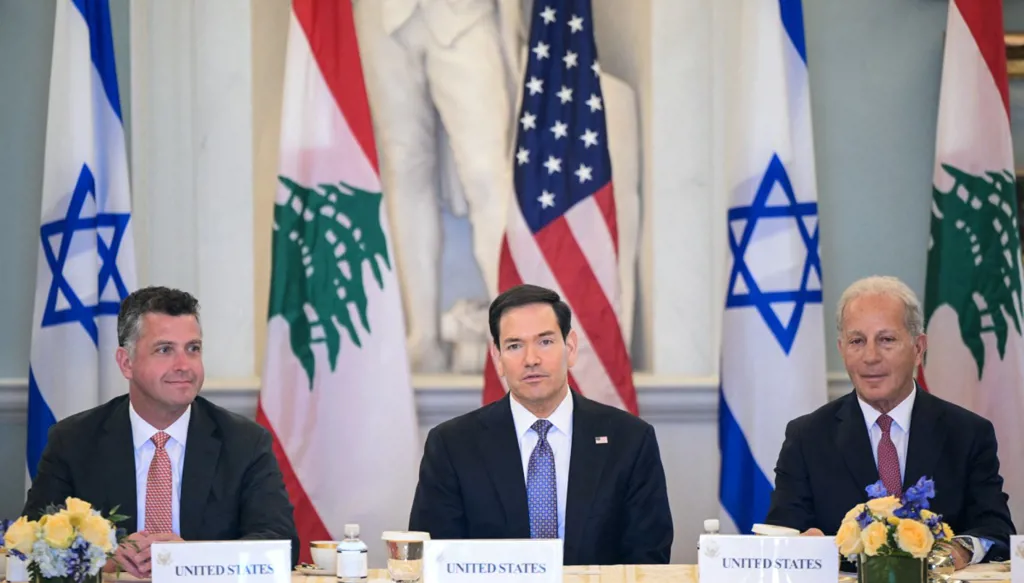


When the Lebanese–Israeli negotiations begin for two days this week, the American president will be on his delayed and highly anticipated visit to China.
There may be no direct connection between the two events, but Donald Trump’s talks with Xi Jinping will inevitably address the American–Israeli war against Iran. As for the war branching out from it, which is now threatening the Lebanese entity, it remains outside the discussion.
Although Beijing has stayed out of the spotlight and its reactions have remained standard, it and Moscow have done what they can to keep Iran capable of keeping the United States preoccupied and to prevent the collapse of its regime.
Before Beijing encouraged Tehran to show “flexibility” to ensure the success of negotiations in Islamabad, it had already recorded two exploitable outcomes: that the war has weakened Iran, and that Washington has not achieved its objectives.
However, China has been and remains affected by the closure of the Strait of Hormuz and is wary of the ongoing crisis over who controls it.
What are Trump’s priorities regarding China?
The war and its developments are not Trump’s priority in Beijing; rather, the focus is on unresolved trade issues. He is not seeking cooperative solutions based on a shared American–Chinese sphere of influence, nor has he ever hinted at such an approach, even though the interests he seeks in Iran after the war may overlap with or conflict with interests China has already secured there.
Nevertheless, Trump needs Beijing in his search for ways out of the current war, and he may find it willing to cooperate if the right price is offered. Some analysts have even suggested the possibility that Trump could abandon Taiwan, though this is considered rushed and an oversimplification.
However, Beijing neither has the ability nor the desire to pressure Iran into a “surrender,” which Washington has clearly made a condition, a point reiterated by Mohammad Bagher Qalibaf. This has led to the stalling of negotiations, even after it was recently announced that both sides were close to reaching an agreement.
Despite expectations that a one-page memorandum to “end the war” would be approved in Islamabad before Trump’s arrival in China, many obstacles could delay or prevent it.
The atmosphere of optimism and accompanying leaks suggested that the American side had softened its core demands, whether regarding the nuclear program, the missile program (which appears to have been removed from the negotiation agenda), or the Strait of Hormuz file.
However, Iran’s delayed response, its exceeding of the 48-hour deadline, and the possibility that it presented a new proposal showed that Tehran hesitated, maneuvered, and then found itself once again facing the same “conditions,” possibly even stricter ones due to the blockade on its ports.
Whenever negotiations stall and the “specter of ending the war” recedes, Israel feels that available opportunities remain open. It stays on alert, awaiting an American signal to resume the war on Iran, while continuing to undermine the Gaza agreement between mediators and guarantors. More importantly, it keeps adding obstacles to negotiations with Lebanon and to the possibility of reaching an agreement there.
In contrast, the United States, Israel, and Iran objectively and implicitly agree that the issue of “Iranian proxies” is always present but is no longer among the priorities of the war or its conclusion.
Washington is closely monitoring it in Iraq and has made the “disarmament of militias” a central condition in the formation of the new government. It also shares this position with Israel in managing the Gaza catastrophe, while considering it an essential condition for stopping the war in Lebanon.
“Not out of courage, but out of necessity”
These are negotiations that Lebanon as a state is entering under compulsion, “not out of courage, but out of necessity.” The one who is compelled is trying to save the country and its people, whereas the “hero,” or whoever sees himself as one, boasts of “resisting occupation,” but ends up drawing in more occupation and sacrificing the country and its people.
Even in the most favorable possible understanding with the United States, Iran will not concede or sacrifice anything in order to end the Israeli occupation in Lebanon. And in the best-case scenario for both the “Party of Iran” and the “resistance,” they are unable to liberate Lebanese territory. The negotiations may carry a fragile hope of possibly regaining it, but at what cost?
Lebanon as a state will be treated as a defeated party in a war it neither wanted nor fought, and therefore it will be required to accept a “peace agreement,” even if that comes at the expense of its internal peace.
The paradox lies in the fact that both external and internal adversaries who worked to weaken the state are now the ones accusing it of heading toward “humiliating” and “surrender” negotiations, and they are also the ones who will work to sabotage these negotiations.
Thus, the Lebanese negotiator proceeds without illusions. The United States wants to separate Lebanon from Iran, and this is also what the state and the Lebanese want.
But the United States supports the Israeli occupation in the south, including displacement of people, destruction of infrastructure, and the stripping of land and landmarks, while trying to present it as strengthening the Lebanese state. In reality, it brings Lebanon back to an atmosphere of sectarian tension, to the period before the year 2000. In other words, it effectively achieves the ambitions of Iran and its “party.”
Disclaimer: The opinions expressed by the writers are their own and do not necessarily represent the views of Annahar.