

China and the Strait of Hormuz: power without direct engagement



 Messenger
 Whatsapp
 Threads
 Email
Email
 Print
Print
 X
X
 Facebook
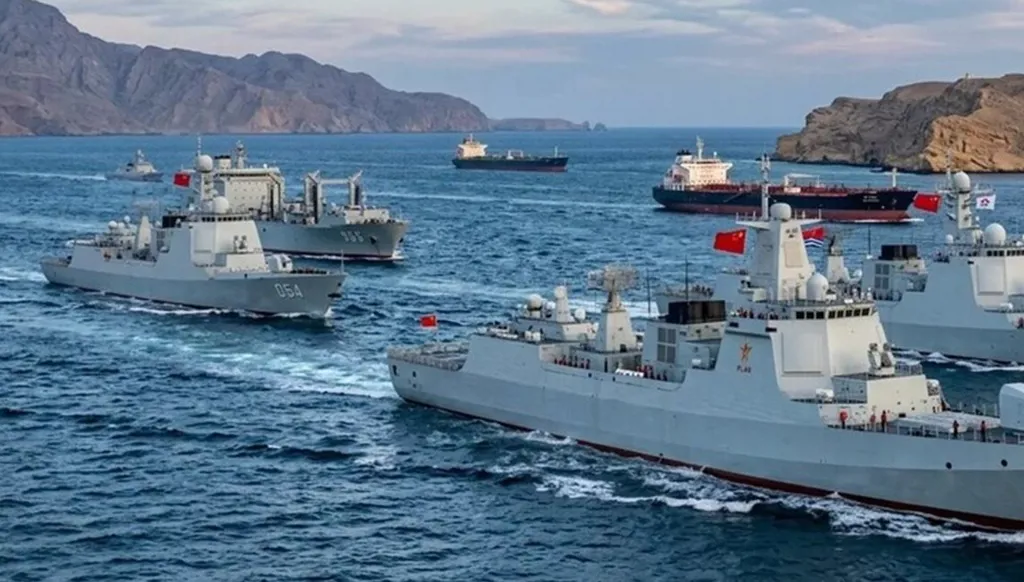


The Strait of Hormuz is no longer viewed as a conventional maritime passage as it once was. It has gradually evolved into a space managed more through security dynamics than through legal regulation. The movement of ships has become subject to overlapping warnings and procedures, issued by Iran on one side of the strait and by the United States on the other, making transit directly dependent on security calculations.
In such an environment, the question is no longer a theoretical one about who holds power, but a practical one: who chooses to use it and who prefers to avoid it.
Within this context, the transformation of the People’s Liberation Army Navy over the past decade stands out. This shift was not simply a technical upgrade, but a clear transition from a coastal defence force to one capable of operating at long distances.
It is closely linked to the protection of China’s supply lines, particularly those passing through sensitive chokepoints such as Hormuz. Beijing has developed a diversified fleet that includes aircraft carriers, heavy destroyers, and submarines with strategic capabilities, along with logistical support vessels that enable prolonged operations far from home waters. This reflects preparedness to operate in distant and complex environments, while still preserving the distinction between having capability and actually using it.
Outside the traditional scope
At the same time, the Chinese navy has gained limited but meaningful operational experience abroad through missions such as escorting ships in the Gulf of Aden over recent years.
This experience has provided practical exposure to operations beyond its traditional sphere, making it a force that can be present when required, not only one that displays capability.
Nevertheless, a paradox remains. Despite possessing these capabilities, China does not take part militarily in managing current tensions in the Strait of Hormuz. This is not due to a lack of capacity, but rather to the nature of its calculations.
China, which depends on this route for its energy supplies, is also aware that any direct military involvement in the Gulf could pull it into long term commitments in a highly complex environment.
It therefore seeks to avoid this through an approach based on risk management rather than military confrontation, maintaining balanced relations with all parties and promoting de-escalation without entering confrontational security arrangements.
However, this approach is being tested as risks increase. When vital sea lanes come under direct security pressure, reliance on non-military tools becomes more limited, raising an unavoidable question: how long can the use of force be postponed if this dynamic continues, especially in light of recent tensions in nearby maritime routes, particularly the Red Sea, and the resulting fluctuations in shipping and insurance costs. These developments directly affect global supply chains on which Beijing heavily depends.
A power with capabilities
What is unfolding in the Strait of Hormuz is not merely a test of the balance of power, but also of how that power is used. Some actors rely on direct military presence to shape maritime rules, while China at this stage chooses to remain outside direct confrontation while maintaining readiness.
This places it in a distinct position: a power with capabilities, but one that does not act as a direct participant in the conflict.
China today is a clear power, yet it does not deploy this power in Hormuz, and this in itself is a deliberate choice rather than an absence. The issue is not the possession of capability, but the timing and limits of its use in an environment that rewards calculation more than impulse.
As pressure on key maritime routes continues, Beijing may eventually reach a stage where indirect presence is no longer sufficient, and where its naval role may need to be redefined beyond observation toward more explicit protection of its vital interests.
Waref Kumayha, Head of the Silk Road Institute for Studies and Research
Disclaimer: The opinions expressed by the writers are their own and do not necessarily represent the views of Annahar.